Reading time: 6 minutes
A Customer Data Platform (CDP) is the layer that unifies customer data from every digital channel a dealer group operates: the website, the telephone, forms, social channels, email, and marketing campaigns. Systems such as the DMS feed the same profile through dedicated integrations, which belong to a distinct layer of the architecture. The CDP resolves the fragmented records these sources hold into a single, authoritative, continuously updated profile per customer, and turns that profile into the base on which segmentation, campaigns, and AI reasoning operate. In automotive retail, where the same person routinely exists under multiple identifiers across separate systems, this unification is the condition that makes every downstream investment more precise.
This article explains how a CDP does its work: how it recognises the same customer across systems, what a unified profile contains, and what changes operationally once it exists.
One customer, seven records
Consider a scenario every dealer group will recognise. A customer exists in the database seven times. A salesperson searches for him, finds six records with slightly different details, and, unsure which one is current, creates a seventh. Marketing sends three emails to the same person, drawn from three different addresses. The BDC opens the wrong record and works the conversation with a fraction of the available history.
The behaviour of every operator in this scenario is reasonable. The problem is structural: each system that touches the customer creates and maintains its own record, with its own identifiers, and the systems hold no shared definition of who this person is. A customer who bought a vehicle three years ago, brought it in for service twice, responded to an email campaign, and submitted a new lead this week can exist across four separate systems with slightly different contact details, and every function that acts on him acts on a partial picture.
This is the specific problem a Customer Data Platform is built to solve, and it solves it at the level where the problem lives: identity.
How identity resolution works
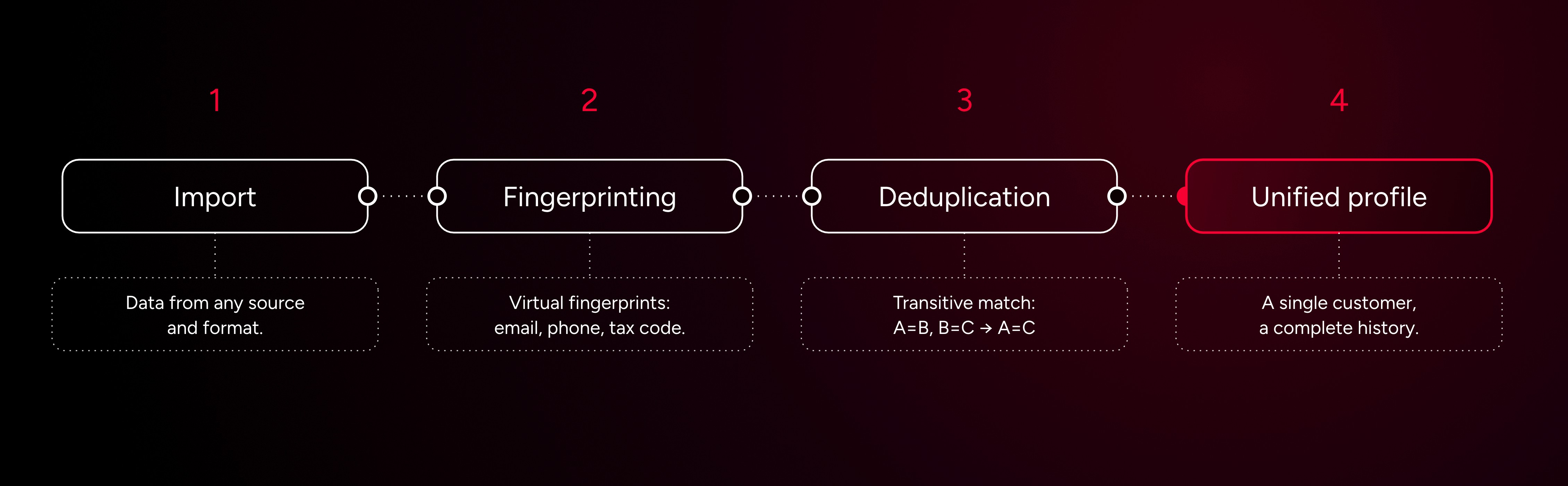
The technical core of a CDP is identity resolution: the process of recognising that fragmented records across systems describe the same person, and merging them into one profile.
The mechanism relies on composite signatures. Every record carries identifiers: an email address, a phone number, a tax code, a name. The CDP treats each identifier as a fingerprint and matches records that share them, accounting for the natural variation these details accumulate over years: a name spelled differently, a personal email in one system and a work email in another, a landline in one platform and a mobile in the call tracking software.
Matching also works transitively. If record A shares a phone number with record B, and record B shares a tax code with record C, then A, B, and C describe the same person, even though A and C hold no identifier in common. This transitive logic is what allows the resolution to reach across channels that never exchanged data directly: a form submitted on the website, a contact reached by an email campaign, and a phone interaction converge into one profile through the chain of identifiers that connects them.

The same logic extends to visitors who have yet to identify themselves. A person browsing the website anonymously produces behavioural data: the vehicle pages viewed, the frequency of return, the finance simulation run. Channel fingerprinting tracks this activity, and the moment that visitor submits a form, the entire anonymous history attaches to the newly identified profile. The lead that arrives is accompanied by weeks of context. A prospect who requested a quote for a new SUV and then returned to browse used vehicles in the same price range is signalling a search for a compromise, and the sales consultant who opens that lead can see it.
What a unified profile answers
Once identities are resolved, the profile can answer four questions about every individual in the database. These four dimensions, introduced in the second white paper of The MotorK Strategy series, define what a customer view needs to contain before intelligence can reason on it reliably.
Who is this person? One authoritative record, reconciled across all connected systems, continuously updated by every interaction. The salesperson who searches finds one result, and it is current.
What have they purchased? The full transaction history: vehicles, contracts, service records, financing, drawn from the DMS where its dedicated integration is in place. This longitudinal dimension establishes where the customer sits in the ownership cycle and what the commercial relationship has been.
How do they behave? Pages browsed on the website, forms submitted, emails opened, campaign interactions, calls placed, touchpoints on social channels. This is the layer of signal most legacy systems miss entirely, and the one that turns a static record into an active indicator of intent.
When is the right moment? Predictive signals that surface before intent is declared. A customer who has stayed away from the workshop for twenty-four months is sending a churn signal. A lease contract expiring in four months opens a decision window. Seven visits to the same vehicle page in two weeks express an intent the sales team should act on. Behavioural timing counts too: a customer whose site activity peaks during the lunch break is telling the organisation when a call will find him available.

Answering these questions from a screen, in real time, changes the texture of daily work. Whether this customer purchased a warranty extension, which leads received no quote in the last thirty days, what communications this person was sent: each of these becomes an immediate answer read from the profile, replacing a report requested from another department.
From profile to action
A unified profile creates its value when it is activated, and the activation begins with segmentation.
A CDP built for the AI era allows segments to be defined in natural language. Two examples of real queries: "customers who submitted a lead for a Volkswagen, browsed Fiat on the site, and have yet to purchase"; "customers with a lead that failed more than thirty days ago and who visited the site in the last seven days". Each query returns a live segment, built on resolved identities and current behavioural data, ready to be pushed towards analysis, retargeting audiences, or automated campaigns.
The size of the segment then determines the channel. A high-intent segment of thirteen people warrants a direct call from the BDC or the sales consultant, one by one. A segment of 3,742 fits marketing automation: email, SMS, automated tasks. A segment of 14,752 feeds retargeting audiences on Google and Meta. The same infrastructure serves all three scales, and the profile behind each contact carries the full context regardless of the channel that reaches him.
The value becomes concrete at the level of a single campaign. Take an email sent to 3,742 recipients: 749 opens, 150 clicks, and, through the traditional lens, three form submissions to work as leads. A CDP identifies the people behind those 150 clicks, because each click belongs to a resolved profile. The campaign surfaces 147 additional potential customers: people who expressed interest, visible and contactable, complete with the browsing history that explains what they were interested in.
An asset that compounds
A CDP follows a different curve from most technology projects: its value grows with time. On day one it switches on and begins to collect. Within months, browsing behaviour, leads, and campaign responses accumulate on resolved profiles. Segments become richer, patterns become visible, and predictions improve because the models behind them are trained on complete records.
This compounding is the strategic reason the layer matters beyond its operational convenience. The intelligence available on the market is available to every competitor. The context is proprietary: how customers interact with one specific business, its page views, its leads, its calls, its history, belongs to that business alone. A well-fed CDP converts that context into a working asset, and every well-managed interaction adds to it. Context is built through operational discipline, one piece of information at a time, and it is the part of an AI strategy a competitor cannot buy.
What is a Customer Data Platform in automotive retail?
What is the difference between a CDP and a CRM?
How does identity resolution work in a CDP?
Can a CDP track visitors before they identify themselves?