Reading time: 5 minutes
Vertical AI does not describe a different category of technology. It describes a state that an organisation reaches when the intelligence it deploys has been so thoroughly grounded in its own domain, its own data, and its own operational history that it begins to reason about that reality with a precision no external system can replicate. In automotive retail, that context is the real competitive advantage: more than the model, more than the technology itself.
There is a scene in Star Wars where Han Solo is preparing to make the jump to hyperspace. Luke asks how long it will take. Han's answer: a moment, the navicomputer still needs to calculate the trajectory. Because, as he explains, travelling through hyperspace is not like dusting crops. Without precise coordinates, you could fly through a star, or come too close to a supernova. The journey would end before it began.
Replace Han Solo and Luke Skywalker with two people at your dealership: one insisting on implementing AI in fifteen minutes, the other explaining why the matter is slightly more complicated, and the parallel is hard to miss. The principle holds exactly: to make the jump, you need two things. The intelligence to navigate, and the context to navigate from.
Vertical AI in automotive retail delivers quality outputs only when it operates in a rich, structured, proprietary context. Without it, even the most sophisticated model navigates blind: producing outputs that are generically reasonable, but operationally imprecise for the specific reality of automotive distribution.
How artificial intelligence actually reasons
The common assumption is that AI reads information and produces answers. The more accurate description is that it navigates.
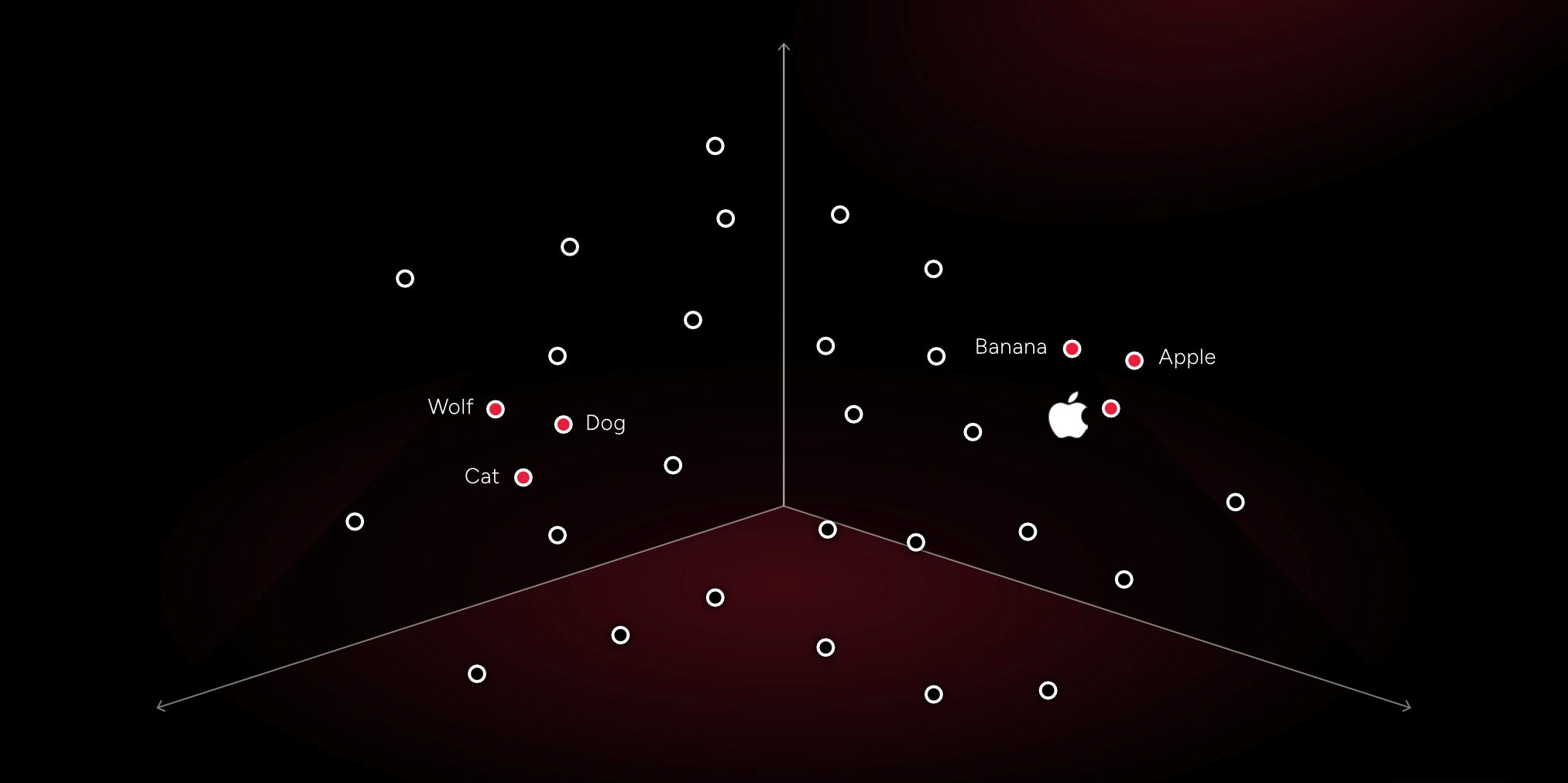
Consider the totality of human language mapped as a multidimensional system of interconnected nodes: every word situated in relation to every other word, every phrase a route through that space. Words with shared meaning cluster together. "Dog", "wolf", and "cat" are neighbours. "Banana" and "apple" are close, but "apple" and "Apple" are close too, because the model has learned both meanings and their contexts.
This is where the quality of context becomes determinative. Ask an AI system for the loyalty rate at year four, and it will navigate towards "loyalty", which sits near "trust", "retention", and "commitment"; towards "rate", which neighbours "measure", "index", and "percentage"; towards "year", which is adjacent to "cycle" and "anniversary". If it reads the constellation correctly and holds all three in the right relationship, it arrives at the right answer.
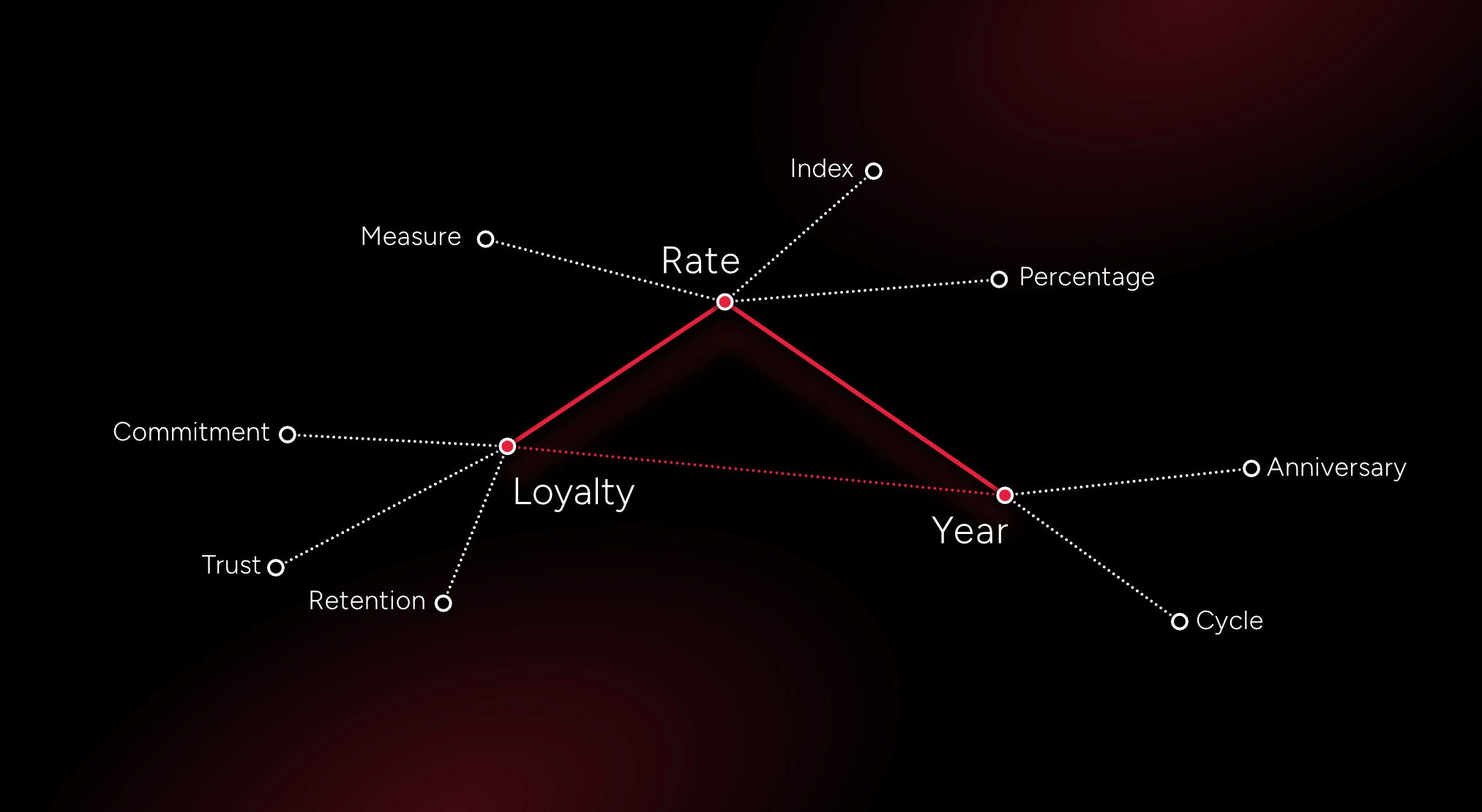
But "loyalty" and "anniversary" share a neighbourhood. So does "year four" and a certain milestone in a marriage. The system can drift, and the less context it has been given, the more likely it is to produce imprecise outputs.

This is not a flaw to be patched. It is the structural reason why the quality of what AI produces is inseparable from the quality of the context it operates on.
Why context and data access are inseparable in automotive AI
Han Solo's navicomputer needed two distinct things: the maps of known space, and the technical capacity to access them and calculate the trajectory. Having only one of the two makes the jump to hyperspace a genuinely dangerous proposition.
The same applies to AI in automotive retail. The model, the intelligence itself, is broadly available. The major foundation models are accessible to any organisation. What is not broadly available, and cannot be procured off the shelf, is the specific context, grounded in your company's data and processes, that the model has to work with: the operational history, customer behavioural patterns, transactional data, service records, and lead conversion dynamics particular to your market, your price points, your customer base.
And even when that context exists within an organisation, accessing it is not automatic. A DMS that does not expose its data through open integrations, an OEM system without the APIs required to connect to it, six separate customer records for the same individual spread across three platforms: these are not edge cases. They are the standard configuration of the typical European dealer group. The context exists. Access to it does not.
Both conditions must be met before the intelligence can function at the level the technology is capable of.
Why generic AI has a structural ceiling in automotive retail
Generic AI systems are trained on vast volumes of data accumulated over years, drawing on the breadth of human knowledge. The quantity of data involved is genuinely impressive, but quantity and depth are not the same thing and in automotive retail, performance lives in depth.
A generic model knows what a lead is. It does not know how leads behave in your specific context: which signals in your database reliably precede a purchase decision, which customer segments respond to which channel at which moment in the journey, what a healthy aftersales retention pattern looks like for your particular mix of brands and geographies. It knows the language of automotive retail. It does not know your operational reality.
Automotive retail is among the most contextually complex sectors in the European economy. It sits at the intersection of global manufacturing, local regulation, personal finance, and purchase decisions shaped as much by emotion as by need. It involves high-value transactions, fragmented customer journeys, significant regional variation, and layered relationships between OEMs, dealer groups, and end consumers. Generic intelligence was not built to reason on this specific complexity: it was built for quantity. Automotive retail demands depth.
The consequence is a structural ceiling: generic AI, applied directly to automotive retail operations without domain-specific context, produces outputs that are generically reasonable and operationally imprecise. It is a capable navigator with incomplete maps.
What Vertical AI is, and what it is not
When we talk about Vertical AI, we do not mean a different category of technology. We mean a state that an organisation reaches when the intelligence it deploys has been so thoroughly grounded in its own domain, its own data, and its own operational history that it begins to reason about that reality with a precision no external system can replicate.
The underlying model may be identical to one used by an organisation in a completely different sector. What differs is what that model has to work with. The maps, to continue the metaphor, are the same navigational system. The coordinates are proprietary.
Two automotive organisations can deploy identical technology and arrive at substantially different results. The difference is not in the software. It is in the accumulated context the software has been trained to reason on: the leads that converted and those that did not, the customer profiles built from years of real interactions, the pricing patterns that correlate with demand in specific markets, the service histories that predict customer behaviour in aftersales. That body of context belongs to the organisation that built it.
This is the compounding dimension of Vertical AI. Each well-structured interaction, each correctly recorded data point, each resolved customer profile adds to the navigational precision available to the system. The model learns from what it is given. An organisation that has fed a well-integrated, well-structured system with high-quality operational data has built something that accumulates over time, and that accumulation is where the durable advantage resides.
How to prepare for Vertical AI: data, integration, and operational maturity
Building the foundations for AI in automotive retail is an organisational problem. It requires a shift in how the business thinks about and works with data, treating it as the raw material from which intelligence is built. It requires a commitment to integration across systems that were often deliberately kept separate. It requires the discipline to deduplicate, clean, and connect customer records before deploying the tools that will reason on them.
The organisations that have reached this level of operational maturity have not simply adopted AI. They have restructured around the conditions that allow AI to function at its full depth. That restructuring is the harder work, and the more valuable one, because it produces something that compounds and self-reinforces: artificial intelligence, when grounded in high-quality proprietary context, generates an advantage that no external system, however powerful, will be able to replicate from the outside.
The navicomputer can calculate the jump. But first, someone has to build the maps.
To explore how artificial intelligence can apply to your business, contact us.
What is Vertical AI?
Why is generic AI not enough for dealers and dealer groups?
How do you build proprietary context for AI?
What is the long-term competitive advantage of Vertical AI?