Reading time: 5 minutes
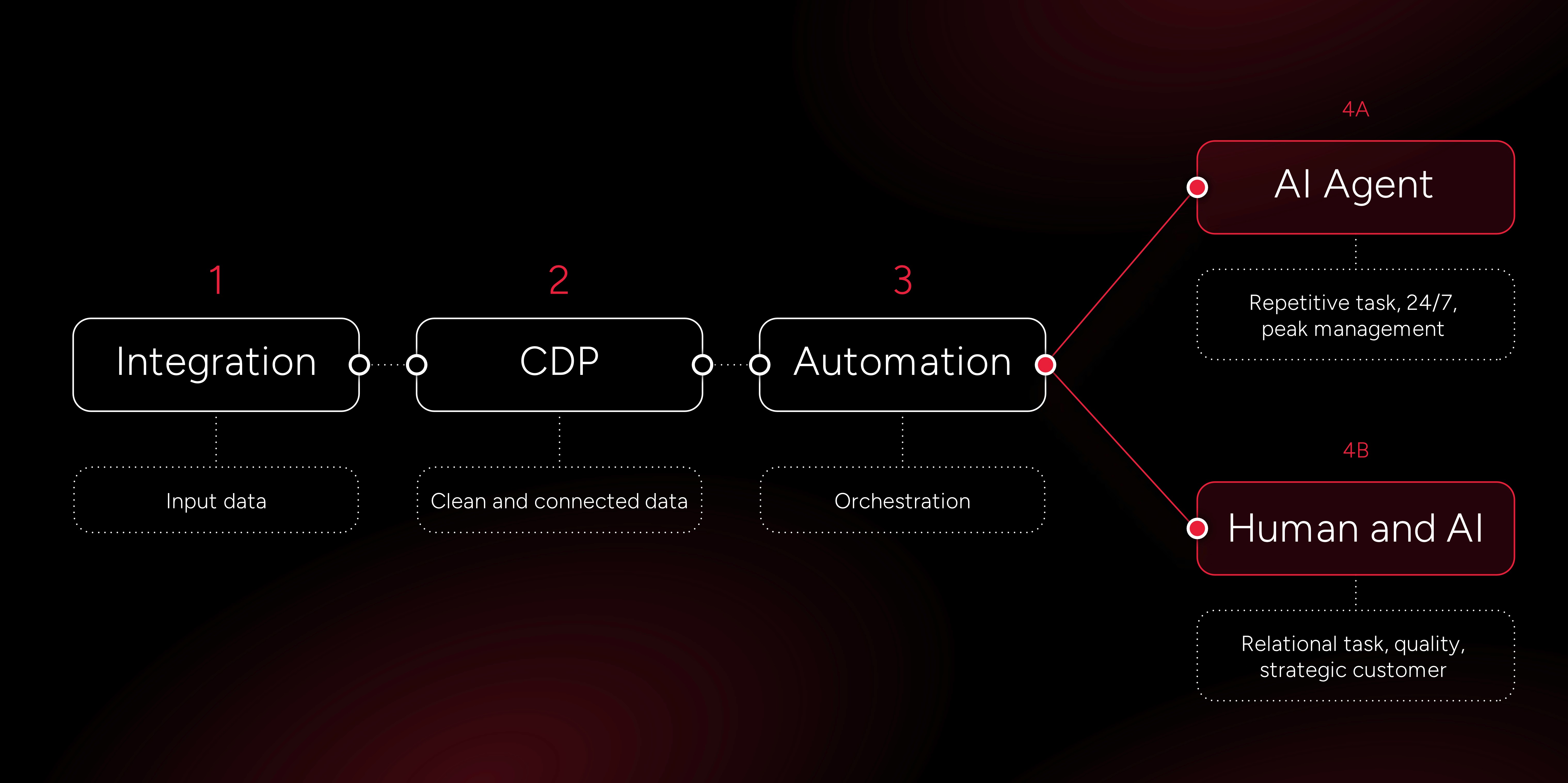
The Context Stack is a four-layer architecture that provides AI systems with the domain-specific context they need to produce reliable outputs in automotive retail. It comprises Integrations, a Customer Data Platform, an Automation and Orchestration layer, and a bifurcation between AI Agents and human operators. Each layer is a structural precondition for the next.
The performance gap between AI deployments that produce measurable results and those that do not is rarely a question of which tools the organisation selects. It is a question of whether the organisation has built what those tools need to operate on: a coherent, connected, progressively enriched body of context: a Context Stack.
The Context Stack is not a single system. It is a sequence of four structural layers, each one a precondition for the next, that together transform scattered operational data into domain-specific intelligence capable of driving decisions. Understanding what these layers are, what each one requires, and why the order matters is the foundational question any dealer group or automotive retailer needs to answer before evaluating any AI investment.
Why the Sequence Is Not Optional
The analogy that captures this best comes from cooking: a recipe with the right ingredients in the wrong order produces the wrong result. The same logic applies to AI infrastructure.
Activating AI-driven personalisation without a unified customer view, or deploying autonomous agents without an orchestration layer, produces outputs that are technically functional but operationally unreliable. The investment is real. The context is missing. The intelligence has nothing solid to reason on.
The four layers of the Context Stack are Integrations, the Customer Data Platform, Automation and Orchestration, and the bifurcation between AI Agents and human operators. Each layer must be functioning before the next one can create value. The architecture is sequential by design.
Integrations: Data Has to Get In Before It Can Do Anything
The starting point is both the most fundamental and the most frequently underestimated. Before any intelligence can be applied, data from across the operational environment must be collected, connected, and made available in a coherent form.
For a dealership or dealer group, the relevant sources are numerous: the DMS (quotes, contracts, workshop updates), the website (which vehicles a visitor has browsed, how many times, for how long), telephone interactions (what was proposed, how the customer responded), social channels, advertising campaign exposure, and aftersales service history. Each of these systems generates data. In the typical automotive retail organisation, few of them are connected to each other.
The consequence is what might be called contextual blindness. If a customer has already booked their next service appointment and that information sits only in the DMS, an AI system operating without that connection will engage them as though the appointment does not exist. If a prospect has visited the website three times in five days and that behaviour is not connected to the lead record in the CRM, the qualification logic will treat them with the same urgency as someone who clicked once and left.
Incomplete context produces systematically misleading outputs, because the system navigates an incomplete map with full confidence. The integration layer is not a one-time project. It is the connective tissue of the entire stack, and its completeness determines the ceiling on everything that follows.
The CDP: From Raw Data to a Customer Worth Reasoning On
Connected data is not yet intelligent data. The second layer of the Context Stack transforms the incoming data flow into something that can actually inform decisions: a single, deduplicated, continuously updated profile for every individual in the organisation's database.
This is the role of the Customer Data Platform. The reason it is structurally necessary, not merely useful, is that AI reasoning on fragmented identities produces fragmented intelligence.
Consider what the typical dealer group's data infrastructure contains: a customer who purchased a vehicle two years ago may appear under different names in the DMS (one entry for sales, one for service), under a different email address in the marketing platform, and under a mobile number in the call-tracking system. Without reconciliation, these are four separate people as far as the AI is concerned. The intelligence applied to each of them will be generic, because the context available for each is partial.
A properly constructed CDP answers four questions for each individual in the database: who they are (reconciled identity); what they have purchased (transaction and service history); how they move (touchpoints, digital fingerprinting, channel behaviour); and when to act (predictive signals indicating proximity to a decision or service need). With these four dimensions in place, the AI has a customer worth reasoning on.
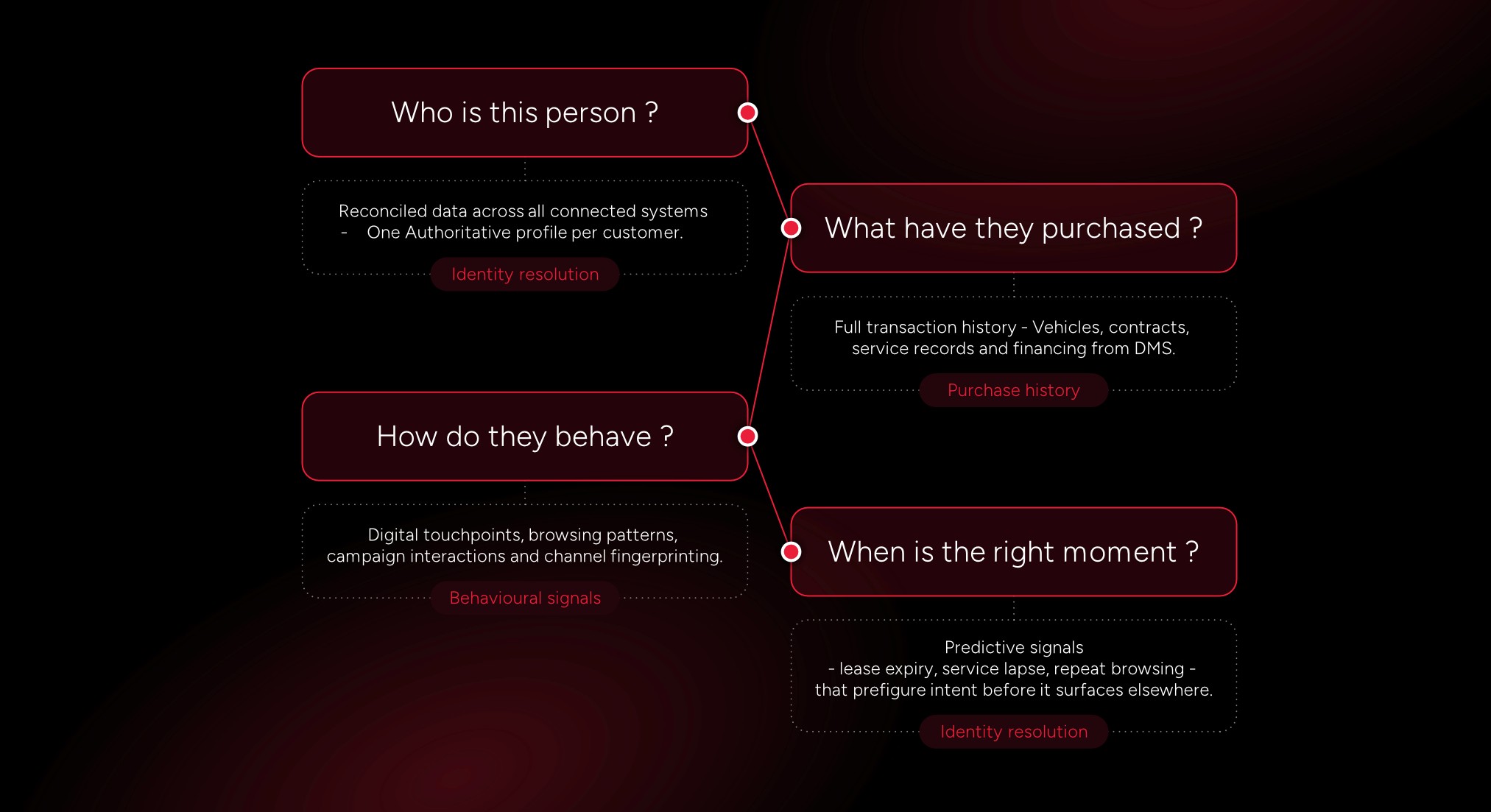
A practical example illustrates the value of this fourth dimension. A customer who consistently does not respond to calls placed between noon and 3pm, but responds reliably to contact after 6:30pm, is providing the system with a behavioural signal. A CDP that has recorded this pattern enables the orchestration layer to act on it: the contact happens when the context is right, the outcome improves, the data point is reinforced. The system learns from each interaction, and the quality of its reasoning improves accordingly.
Automation and Orchestration: Turning Intelligence into Action
The third layer is where insight becomes operational. Having good data and having a system that can act on it are two different things. The orchestration layer is what connects them.
Orchestration governs what happens next. It receives signals from the CDP, applies the workflows the organisation has defined, and determines which action to trigger, via which channel, at which moment, for which individual. It functions as a director: it does not generate intelligence, but it determines how intelligence reaches the customer.
The customer journey in automotive retail has become a branching tree of possible paths, where a single interaction can take the relationship in fundamentally different directions depending on how it is handled. Orchestration maps this complexity and manages it systematically.
Some concrete examples of how this works in practice: a new lead arrives outside business hours, and the system triggers an immediate response rather than leaving it unaddressed until morning. A customer stops engaging after several outreach attempts, and the orchestrator shifts to a different modality - perhaps a brief structured survey to understand what has changed - rather than repeating the same failed approach. A customer's leasing contract is approaching expiry, and the orchestrator identifies the moment, segments the individual based on their profile and history, and initiates the appropriate sequence: an automated touchpoint to open the conversation, followed by a task for a sales professional to follow up personally.
Every one of these scenarios requires two things that only the orchestration layer can provide: the ability to see the whole process, and the authority to connect its parts.
The Bifurcation: Where Agents Operate and Where People Lead
The fourth layer is where the most consequential design decision is made. The question is a considered one: which type of intelligence creates the most value in which type of interaction?
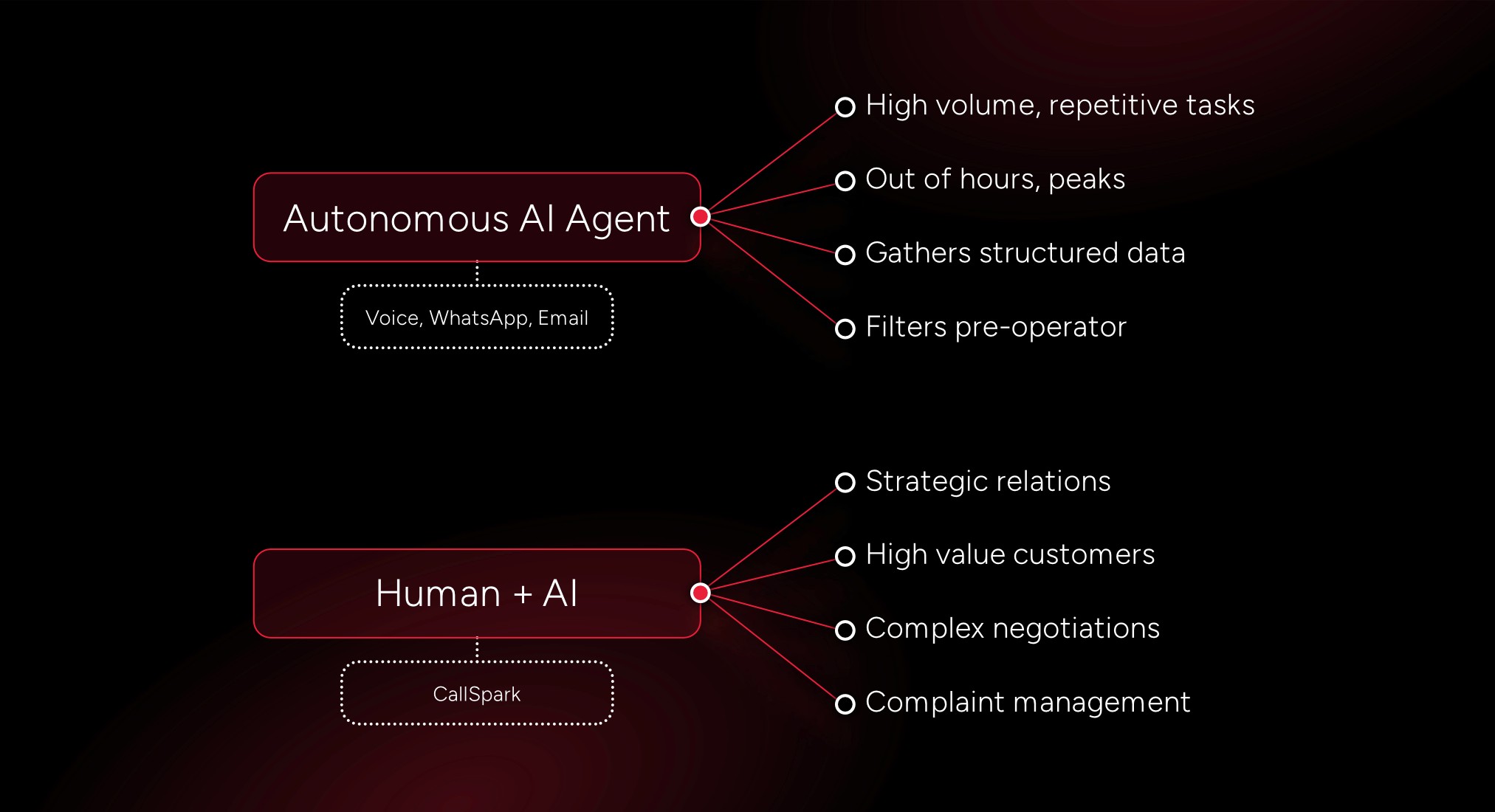
AI Agents are most effective in conditions of high volume, repetition, and operational continuity outside normal working hours. Lead qualification at initial contact, service reminders, test drive slot confirmation, re-engagement of cold leads, post-purchase NPS surveys: these are tasks where speed, consistency, and availability matter more than the relational character of the person delivering them. An agent that contacts a prospect on WhatsApp within minutes of a web enquiry, collects the initial qualification information, and creates a structured task for the relevant sales consultant has handled the most time-sensitive part of the process with precision and without delay.
Human operators, supported by AI, carry a different and irreplaceable set of capabilities. Strategic clients, complex negotiations, complaint escalation, interactions where relational continuity has been built over time: these are the situations where empathy, contextual sensitivity, and the ability to respond to what is unsaid determine the outcome. AI prepares the ground for these interactions: it gives the sales professional a complete, contextualised view of the customer before the conversation begins, transcribes and analyses what follows, and surfaces signals that might otherwise be missed.
The practical design question is therefore: which use cases go to autonomous agents? Which requires human involvement from the first contact? And which should begin with an agent and escalate to a person based on a specific trigger: an expression of dissatisfaction, a high-value signal, or a request the agent is not configured to handle? These decisions constitute the operational architecture of an AI-enabled dealership. Defining them explicitly, rather than allowing them to emerge by default, is what makes the bifurcation a strategic asset rather than an unmanaged process.
What the Stack Produces Over Time
The value of the Context Stack compounds. Each lead correctly qualified, each customer profile enriched with a new interaction, each orchestrated sequence completed and recorded adds to the context available for the AI to reason on.
The system learns from what it is given, and the quality of what it is given improves with every well-structured interaction. This is the process through which an organisation reaches Vertical AI: a state that an organisation reaches when the intelligence it deploys has been so thoroughly grounded in its own domain, its own data, and its own operational history that it begins to reason about that reality with a precision no external system can replicate.
The practical markers of that state are measurable. Lead qualification accuracy improves: the system surfaces patterns specific to your customer base, which signals reliably precede a purchase decision in your context, and which do not, rather than applying generic scoring logic. Orchestration sequences become more precise over time: the system has learned which channel, which moment, and which message works for which customer segment in your market, not in the abstract. Agent performance improves with volume: an agent that has handled thousands of interactions within your specific operational environment responds with a contextual precision that a freshly deployed agent cannot replicate.
None of these outcomes is visible on day one. They emerge from the accumulation of well-structured data over time. And that accumulation is precisely what cannot be shortcut: context, unlike software, cannot be procured. It is built through operational discipline, one well-structured data point at a time.
Where to Begin
Every subsequent layer depends on the quality and completeness of the data flowing in. A CDP built on incomplete integrations produces a partial view of the customer. Orchestration logic applied to a partial view triggers actions based on incomplete signals. Agents operating without adequate context make decisions that are technically accurate but practically misaligned.
The right question at the outset is: "what do we need to build before AI tools can be worth deploying?" The answer is the Context Stack. Building it is the first strategic act, and the one that makes every subsequent investment in AI more precise, more effective, and more grounded in the specific reality of the organisation deploying it.
To explore how this architecture applies to your organisation, get in touch with us.
What is a Context Stack in AI?
Why does AI need domain-specific context to work in automotive retail?
How does a Customer Data Platform improve AI performance?
How long does it take to build a Context Stack?