Reading time: 3 minutes
The value AI produces in a business depends less on the model chosen and more on the context that model reasons on. Complete, structured, and consistent data allows artificial intelligence to read reality and act with precision; fragmented and poorly managed data forces it to reason on a partial picture, with outputs that are only apparently correct, built on incomplete information. We measured the difference between the two scenarios with one of our customers, and the numbers speak for themselves: the same company, the same predictive model, and a workshop visit conversion rate that rises from 6.5 to around 14 per cent.
The principle is clear: AI returns the quality it receives. On a solid data foundation it multiplies value; on a disorganised one it multiplies errors, at the speed automation makes possible.
Data as a Competitive Advantage
In automotive retail, the starting condition is almost always the same: years of customer data accumulated and dispersed across the DMS, the CRM, a marketing platform, the website analytics. Each system holds reliable data within its own perimeter, but together they produce isolated silos, in which the same customer can exist several times under different identifiers, each with a partial history. This is the fragmentation a CDP was created to resolve: a single, reliable profile for every customer, fed by all systems and kept consistent over time.
As long as processes remain manual, the fragmentation goes largely unnoticed: people compensate, cross-reference information, fill the gaps with experience. The cost is there nonetheless, paid every day in time taken away from the customer and in opportunities no one gets to see. With AI, the picture changes twice over: on one side, every person expresses their full potential when working alongside the intelligence; on the other, the intelligence acts at scale and autonomously, and amplifies whatever it finds. This is why data has become a competitive advantage in its own right: organisations with clean, structured, well-organised data extract from AI a value that competitors, with the same technology, simply do not see.
A Case Study: Data as the Basis of Added Value
A case study we conducted on the data of one of our customers provides the proof, and is based on a predictive AI system applied to aftersales services: drawing on the history of each end customer, the system estimates the probability that within the following 60 days they will make a predictable workshop visit, such as a tyre change, a routine service, or a brake replacement.
Compared side by side, the two configurations tell a story. In the first, customers cluster in the lower score bands: the system struggles to distinguish who is close to a service event from who is far from it, and the annual conversion into workshop visits stops at 6.5 per cent. In the second, the distribution shifts towards the higher bands: the scoring becomes more precise, the predictions more reliable, and conversion reaches around 14 per cent.
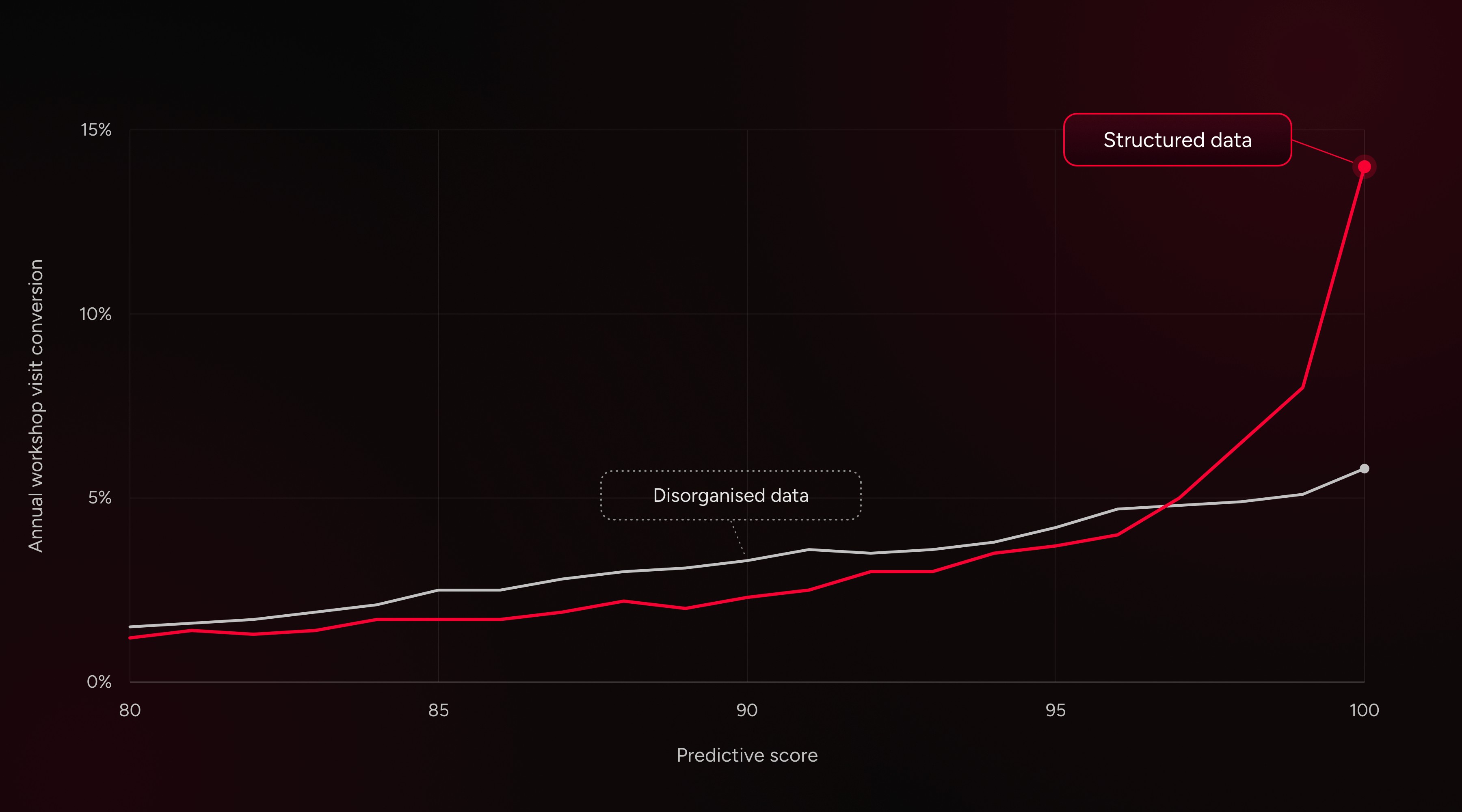
Reading the two curves reveals the mechanism. When the system has access to complete, consistent histories, it recognises with greater confidence the signals that anticipate a service event: it concentrates actions on the right customers, at the moment when contact is relevant. The precision of the scoring thus translates into workshop visits and, for the end customer, into a better experience, made of relevant proposals in place of generic communications.
What the Difference Is Worth
The distance between 6.5 and around 14 per cent is worth 7.5 percentage points. Translating it into economic value takes nothing more than a transparent calculation, built on declared assumptions. On a database of 100,000 customers, 7.5 additional conversion points equal around 7,500 additional workshop visits every year. The average revenue per customer, drawn from real invoices (which the AI itself reads and interprets), stood at around €290: the value of the difference therefore reaches around €2.17 million in additional annual revenue.

The final result depends on the size of the customer base, and every operator can rerun the calculation on their own volumes. The structure of the calculation stays identical: conversion points gained, multiplied by the size of the database, multiplied by the average revenue per customer.
Aftersales, however, is only one of many possible scenarios. The same dynamic applies wherever AI is asked to reason on customer data: in lead qualification, in campaign segmentation, in the personalisation of purchase journeys. The case demonstrates the mechanism; the mechanism applies across the entire value chain.
The Decisive Variable Is Organisational
The detail that cannot go unnoticed is what stayed the same: same company, same database, same AI model. The difference between the two curves comes entirely from the shift from poorly managed data to data managed in a structured way: complete profiles, information consistent across systems, interactions recorded in structured form.
This confirms a pattern we observe consistently across the sector. The conditions that produce reliable data are organisational in nature: technology enables them and makes them sustainable over time, and expresses its full value when the organisation supports it with clear decisions on responsibilities, completeness standards, and process quality. Tools and organisation grow together: the former provide the capability, the latter the direction.
For dealers, this shifts the starting question from which AI should we adopt? to which data can we let it reason on?. It is a question that can be addressed immediately, on the systems already in place: establishing who answers for data quality at each stage, what a record must contain to be considered complete, how discrepancies between systems get resolved. Every answer given today increases the return on every investment made tomorrow.
How to Get Started
For those evaluating AI investments, or who have already made them, the lesson is clear: the starting point must be the state of the data the tools will be asked to reason on. That is, how many systems hold it, how many duplicate identities it contains, how much of it is structured, and who is responsible for its quality.
The answers to these four questions compose an objective picture of the starting point and, together, the map of interventions: where to eliminate duplicates, which systems to connect, which processes must begin producing structured information. Every step taken on this map immediately increases the yield of the tools already active and prepares the ground for those to come.
Putting data first means exactly this: preparing the context the intelligence will be asked to reason on. That is where the value of AI is decided, before it is even switched on.
Why does data quality determine the value produced by AI?
Is there measurable evidence of the impact of data on AI performance?
Does the AI model need replacing to improve results?
How can a dealer assess the readiness of their data for AI?